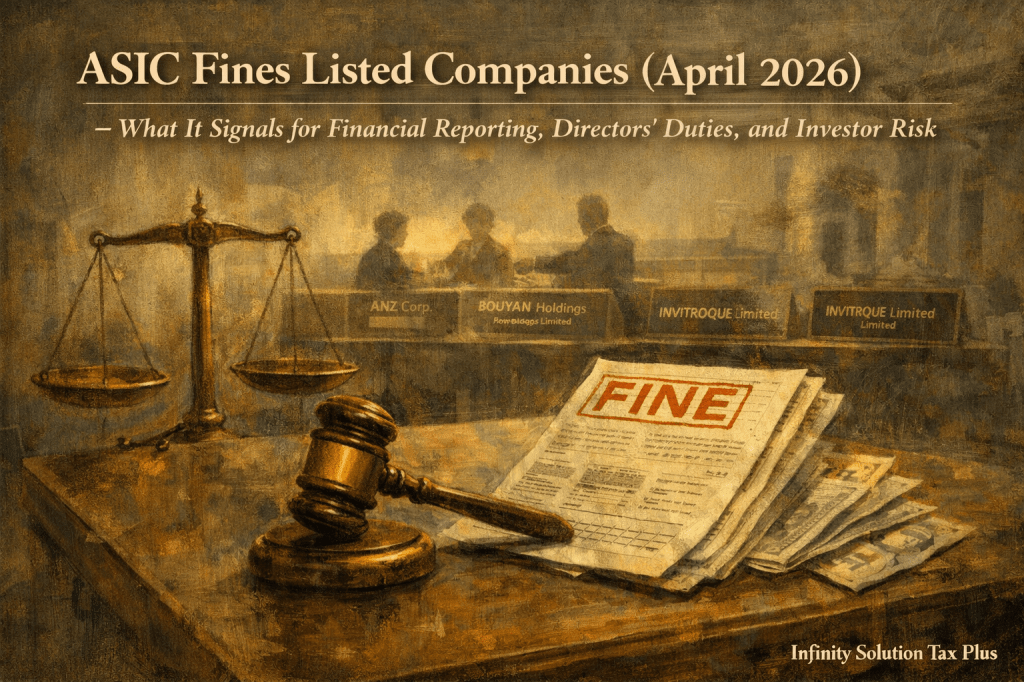
ASIC’s latest enforcement action is a timely reminder that “boring” compliance, lodging accounts on time and maintaining the right officeholders, isn’t optional. On 1 April 2026, ASIC reported that three public companies were fined a combined $1.17 million in a single day at the Downing Centre Local Court for failing to meet core public-company obligations.
For investors and business owners, this matters because financial reporting is one of the main ways markets and counterparties assess risk. From an accountant Box Hill
perspective, the lesson isn’t only for large or complex groups—any company that relies on external funding, suppliers, or customer trust benefits from a disciplined reporting timetable and clear governance.
What happened: the compliance failures ASIC targeted
ASIC’s release (as publicly reported) names the three public companies and the nature of their breaches:
- Urban Ecological Systems Limited: convicted of failing to lodge annual reports for multiple years and fined $240,000
- Invitrocue Limited: convicted of failing to lodge annual reports and failing to have the minimum number of directors for a period, fined $530,000
- Boyuan Holdings Limited: convicted of failing to lodge annual reports and failing to maintain minimum officeholder requirements (including secretary/directors), fined $400,000
ASIC noted the companies were convicted and fined on 17 March 2026.
The legal backbone: why these rules exist
ASIC’s broader messaging is consistent: timely financial reports help shareholders, creditors, and the public make informed decisions, and they support confidence in the financial system. That is why ASIC has been lifting its enforcement focus on non-lodgement and governance failures.
For context, ASIC has highlighted that lodgement rules sit within the Corporations Act framework, requiring certain entities (including public companies) to prepare financial reports, and that lodgement timeframes vary by entity type.
What it signals for investors
When accounts aren’t lodged on time, investors and lenders lose visibility on basic questions: liquidity, solvency, related-party dealings, and whether the business is still a going concern. Repeated late or missing reporting can also be a practical risk flag that governance and resourcing (finance, audit, and board oversight) may be under strain.
If you invest directly (shares) or indirectly (managed funds/super), the practical takeaway is to treat persistent disclosure gaps as a signal to dig deeper—especially when paired with frequent capital raisings, abrupt strategy changes, or recurring board turnover.
Implications for directors and companies
For directors, this is a compliance “must-have,” not a “nice-to-have.” The enforcement outcome also shows ASIC is willing to pursue court-based penalties where obligations are ignored over multiple years—particularly where minimum officeholder rules are also breached.
If you’re running a company that is growing quickly (or sits near the “large” thresholds), it’s worth doing a proactive obligations check now, including financial reporting status, governance structure, and a calendar that ensures audits and lodgements are locked in well before deadlines. A Box Hill accountant can help you build a practical compliance timetable and evidence trail, so issues are fixed early rather than under regulator pressure.
Final thoughts
ASIC’s message is consistent: transparency and governance underpin market integrity, and enforcement can follow where reporting obligations are repeatedly ignored. If you’re tracking policy or disclosure settings, it’s best to follow specific, current consultation pages (rather than relying on general portals) so you’re reading the exact proposals that may affect reporting over time.
If you want a second set of eyes on governance and reporting readiness, a trusted accountant in Box Hill can help you tighten processes before small gaps become expensive ones.
Disclaimer: This article contains general information only and does not constitute financial or taxation advice. You should seek personalised advice from a registered tax or financial professional.




 Infinity Solution Tax Plus