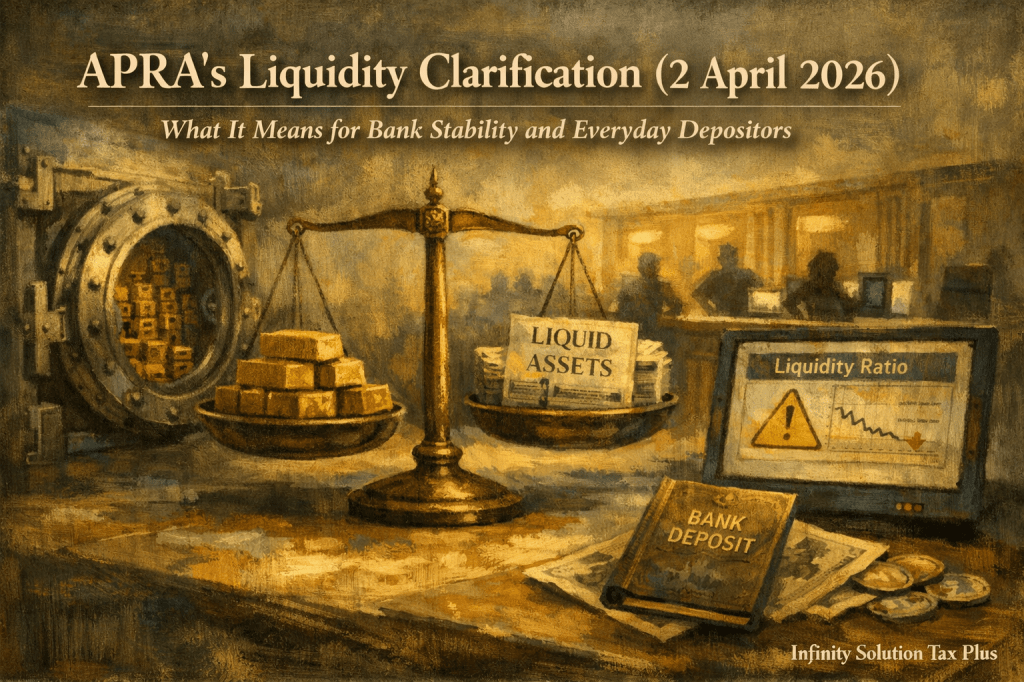
APRA has issued guidance aimed at tightening consistency in how some smaller banks and mutuals measure “liquidity”, the pool of assets a bank can quickly access to meet withdrawals and payment obligations. The change comes via an industry letter released on 2 April 2026, focused on how Minimum Liquidity Holdings (MLH) banks treat deposits they hold with settlement service providers (third parties that process payments on a bank’s behalf).
For households, this is not a “rates” announcement, and it doesn’t change your day-to-day banking features. But it is part of the plumbing that supports confidence in the system, the same reason a local accountant Box Hill will often encourage clients to understand where their money sits and what protections apply before a problem emerges.
What APRA clarified
APRA says it has observed inconsistent treatment among Minimum Liquidity Holdings (MLH) banks about whether deposits placed with settlement service providers can be counted as “liquid assets”. The letter’s purpose is to consult on a draft FAQ and help ensure consistency across MLH banks.
The core rule is about encumbrances. APRA references APS 210 and notes that amounts tied up to facilitate or secure settlement obligations — where the money is not really available to the bank as a source of liquidity — should not be treated as MLH liquid assets. Deposits with settlement providers can be counted where they are unencumbered and available for use by the bank.
Importantly, APRA also states this clarification supersedes previous APRA communications on this specific treatment, acknowledging that history contributed to differences in practice.
Why this matters for stability
Liquidity rules exist to reduce the risk that a bank faces a cash crunch during stress — for example, if customers withdraw funds quickly or wholesale funding tightens. APRA’s own explainer is clear: banks are required to hold liquid assets that can be quickly converted to cash, and the key ratios for banks are the Liquidity Coverage Ratio (LCR) or the Minimum Liquidity Holding Ratio (MLH).
When deposits placed with settlement service providers are effectively “locked up” as security, counting them as liquid can overstate a bank’s resilience. APRA’s clarification pushes MLH banks toward a more conservative and comparable view of what is genuinely available in a crunch.
What should everyday depositors take away?
For most people, the practical message is reassurance: Australia has a formal depositor safety net. Under the Financial Claims Scheme, deposits are protected up to $250,000 per account holder per ADI (bank, building society, or credit union) incorporated in Australia and authorised by APRA.
If you hold more than $250,000 with one institution (including brands under the same banking licence), APRA provides a deposit checker to help people understand coverage and structure accounts sensibly.
Implications and who is most affected
This guidance is targeted at MLH banks, which are typically smaller or less complex institutions than the largest banks. APRA is asking for feedback by 24 April 2026, proposing that the treatment be reflected in September 2026 quarterly liquidity reporting, and expects to publish a final FAQ and implementation timeline by 15 May 2026.
For customers, you’re unlikely to see direct product changes. The bigger impact is behind the scenes: some institutions may adjust what they count as truly liquid assets and how they structure settlement-related deposits to align with APRA’s clarified approach. If you’re a business treasurer or SMSF trustee managing larger balances, that’s where a trusted Box Hill accountant can help you sanity-check counterparty exposure and deposit limits across institutions.
Final thoughts
APRA’s message here is consistency and realism: liquidity should mean “available when needed,” not simply “sitting somewhere on a balance sheet.” With consultation milestones falling in April–May 2026 and reporting changes expected from September 2026, it’s a reminder that stability work often happens quietly — and that informed deposit structuring is still worth doing early.
If you’d like help mapping cash holdings against the $250,000 cap or reviewing how multiple banking brands sit under one licence, a trusted accountant in Box Hill can assist with a practical, compliance-first approach.
Disclaimer: This article contains general information only and does not constitute financial or taxation advice. You should seek personalised advice from a registered tax or financial professional.