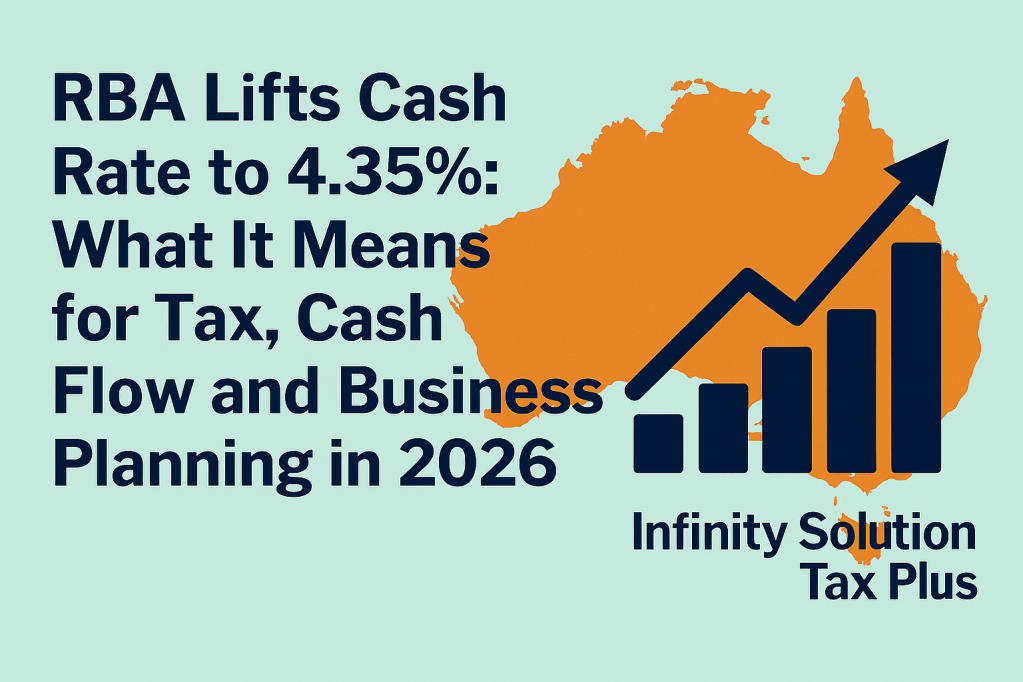
The Reserve Bank of Australia (RBA) has increased the official cash rate by 25 basis points to 4.35% in May 2026, marking the third rate rise this year and fully unwinding the interest‑rate cuts delivered in 2025. The RBA cited renewed inflationary pressure—particularly from fuel prices and global economic instability—as the key driver of the decision, signalling that inflation control remains the priority despite mounting household and business stress. [rba.gov.au], [abc.net.au]
For businesses across Melbourne and the eastern suburbs, including those working with an accountant in Box Hill, this shift has immediate and practical implications for cash flow, tax planning, and year‑end strategy.
Higher interest rates directly increase the cost of variable‑rate business loans, overdrafts, and equipment finance. While interest expenses remain tax‑deductible, the timing mismatch between higher repayments and tax relief can strain working capital—particularly for SMEs operating on tight margins. Businesses should reassess cash‑flow forecasts, debt servicing capacity, and lender covenants now, rather than waiting for financial stress to surface later in the year. [rba.gov.au]
From a tax planning perspective, rising interest costs can materially affect profit allocation strategies. For family groups using discretionary trusts, lower net income may limit distribution flexibility and increase the risk of sub‑optimal allocations. This is especially relevant as the ATO continues to scrutinise trust distributions and beneficiary entitlements ahead of the 2026 tax season. Proactive modelling with a Box Hill–based accountant can help ensure distributions remain defensible and tax‑effective under current conditions. [ato.gov.au]
Property investors are also feeling the pressure. With borrowing costs now back at pre‑2025 levels, many leveraged investors face reduced cash flow without corresponding rental growth. This raises important questions around negative gearing sustainability, asset holding structures, and long‑term viability. The RBA has acknowledged that higher rates are painful for mortgage holders, but has been clear that inflation risks outweigh short‑term relief considerations. [abc.net.au]
Compounding these challenges is the impending introduction of Payday Super from 1 July 2026, which will require employers to remit superannuation contributions in line with each payroll cycle. Combined with higher interest costs, this reform significantly tightens cash‑flow tolerance for non‑compliant or poorly prepared businesses. The ATO has released multiple guidance updates in May, emphasising system readiness and employer accountability.
At a policy level, economic uncertainty is expected to persist through the remainder of 2026. Treasury consultations on the global minimum tax (Pillar Two) and continued expansion of ATO compliance programs suggest that regulatory pressure will not ease, even as economic conditions tighten. This reinforces the need for forward‑looking, scenario‑based planning rather than reactive tax lodgement. [treasury.gov.au], [ato.gov.au]
What should you do now?
Business owners, investors, and family groups should use this period to review debt structures, reassess cash‑flow assumptions, and update tax strategies before 30 June. Working with a proactive accountant in Box Hill ensures these decisions are grounded in current law, economic reality, and ATO expectations—reducing risk while preserving flexibility.
Disclaimer
This article is general information only and does not constitute financial, taxation, or legal advice. It has been prepared without regard to your objectives, financial situation, or needs. You should seek advice from a qualified tax adviser or accountant before acting on any information contained in this article.