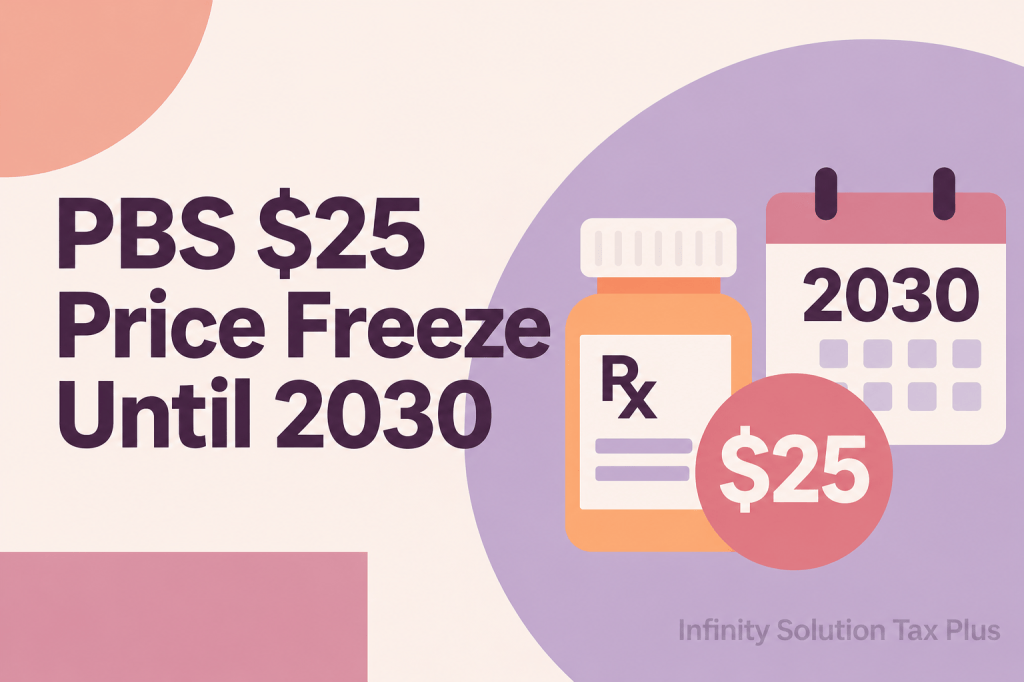
The Australian Government has announced plans to freeze the maximum general patient co-payment for Pharmaceutical Benefits Scheme (PBS) medicines at $25 until the end of 2030, providing greater certainty for households managing ongoing healthcare expenses.
Announced on 23 November 2026, the proposed extension builds on the reduction in the general PBS co-payment from $31.60 to $25 that took effect on 1 January 2026. The Government has committed $242.6 million to the measure, which is intended to prevent annual inflation adjustments from increasing the maximum patient contribution.
For households reviewing their expenses with an accountant box hill, understanding these changes can support more accurate financial planning.
Australian Government – PBS Co-payment Freeze
What Is Changing Under the PBS?
The PBS subsidises eligible prescription medicines, reducing the amount patients pay at pharmacies.
Under the Government’s announcement, the maximum general co-payment would remain at $25 rather than increasing annually with inflation from January 2027.
The key arrangements are:
- General patients: Maximum PBS co-payment of $25 per eligible prescription.
- Concession cardholders: Maximum co-payment remains frozen at $7.70 until 2030.
- Implementation: The proposed extension of the general co-payment freeze requires legislation.
- Additional charges: Certain medicines may attract brand premiums above the standard co-payment.
The freeze applies to the maximum patient contribution, not necessarily the price of every medicine. Some PBS medicines already cost less than $25.
Department of Health – PBS Co-payments
How Could the Freeze Affect Household Budgets?
Healthcare expenses can represent a recurring financial commitment, particularly for people managing chronic conditions or purchasing multiple prescriptions each month.
For illustration, a household purchasing four eligible PBS prescriptions charged at the maximum general co-payment would spend $100 in a month, excluding additional premiums. Actual household costs depend on the medicines dispensed, pharmacy pricing and any applicable premiums.
If legislated, the maximum general PBS co-payment would remain at $25 until the end of 2030. Actual prescription prices may vary depending on the medicine, pharmacy and applicable brand premiums.
Importantly, the announcement does not provide an additional immediate $6.60 reduction. That saving was introduced in January 2026 when the general co-payment fell from $31.60 to $25.
The new proposal focuses on preventing future increases rather than introducing another price cut.
ABC News – PBS Medicine Price Freeze
Who Stands to Benefit?
The proposed extension could provide greater budget certainty for several groups:
- Working families: More predictable prescription expenses.
- People with chronic conditions: Protection against increases in recurring medicine costs.
- Retirees and concession cardholders: Continued access to the existing $7.70 concessional co-payment freeze.
- Households under financial pressure: Greater certainty when allocating income between healthcare and essential expenses.
Patients should also consider whether they qualify for PBS Safety Net benefits or 60-day prescriptions. These arrangements may further reduce overall medicine costs, but eligibility requirements apply. In particular, 60-day prescriptions are available only for certain medicines and eligible patients, subject to the prescribing clinician’s assessment.
Department of Health – Cheaper Medicines
Financial Planning Considerations
Although the proposed freeze offers some relief, prescription expenses remain one component of broader household budgets.
Families should continue reviewing healthcare spending alongside mortgage repayments, insurance, utilities and other essential commitments.
Infinity Solution Tax Plus, as a trusted Box Hill accountant, supports individuals and families with tax-related planning and understanding their broader financial obligations.
For households managing fluctuating income or significant ongoing expenses, maintaining a realistic budget remains important.
Final Thoughts
The proposed extension of the $25 PBS co-payment freeze until 2030 represents a targeted measure to protect Australian households from future increases in subsidised prescription costs.
While the policy may improve cost certainty, its full implementation depends on the legislative process.
Australians should monitor official announcements and review their household budgets as economic conditions change.
Working with a trusted accountant in Box Hill can help households better understand their taxation obligations and plan for upcoming financial commitments.
Disclaimer: This article contains general information only and does not constitute financial or taxation advice. You should seek personalised advice from a registered tax or financial professional.