Australia’s Labour Market Shows Signs of Slowing
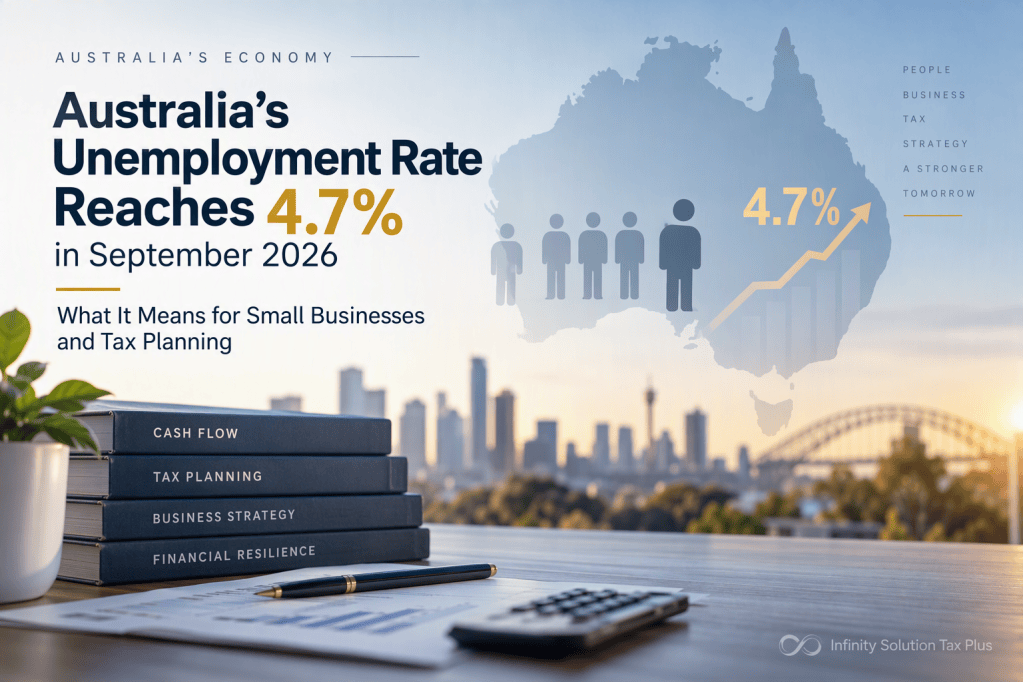
Australia’s unemployment rate reached 4.7% in September 2026, highlighting emerging challenges for businesses and households. The Australian Bureau of Statistics (ABS) reported a decline of 39,300 employed people, while the number of unemployed Australians increased by approximately 8,900.
The unemployment rate remained at 4.7% following an upward revision to August’s figures, placing it at its highest level in the post-pandemic period. The latest figures suggest that employment conditions are becoming less favourable, although longer-term labour market trends remain relatively stable. ABS Labour Force Data
For business owners and taxpayers, these developments reinforce the importance of financial preparedness. Working with an experienced accountant Box Hill businesses can consult, may help identify practical strategies to manage cash flow, tax obligations and financial uncertainty.
What Is Driving Australia’s Labour Market Slowdown?
The September figures indicate softer employment conditions amid persistent inflation concerns, elevated borrowing costs and pressure on household budgets.
Key labour market indicators include:
- Unemployment rate: 4.7%, up 0.1 percentage points on the revised August estimate.
- Employment: Down 39,300 people.
- Participation rate: Declined to 66.8%.
- Employment-to-population ratio: Fell to 63.6%.
- Underemployment rate: Increased to 6.3%.
Importantly, full-time employment increased by 34,400 people, while part-time employment declined by 73,700. This suggests the weakness was unevenly distributed across employment categories. The ABS also cautions against overinterpreting monthly movements, with the trend unemployment rate remaining at 4.6%.
For the Reserve Bank of Australia (RBA), weaker employment growth adds complexity to monetary policy decisions. Although softer labour demand may reduce inflationary pressures over time, persistent price increases could limit opportunities for interest rate relief.
What Does Higher Unemployment Mean for Small Businesses?
A weakening labour market can influence consumer confidence, spending patterns and business investment decisions.
Businesses operating in retail, hospitality, construction and discretionary services may be particularly exposed if households reduce non-essential expenditure.
Small business owners should consider:
- Reviewing cash flow forecasts and operating expenses.
- Monitoring overdue invoices and customer payment behaviour.
- Assessing workforce productivity and recruitment requirements.
- Maintaining sufficient working capital for tax and payroll obligations.
- Reviewing expansion plans against realistic revenue expectations.
A proactive Box Hill accountant can assist businesses in evaluating these risks and developing financial strategies aligned with their circumstances.
Tax Planning and Cash Flow Strategies for 2026–27
Economic uncertainty makes forward-looking tax planning increasingly important.
Businesses should review legitimate deductions, applicable depreciation concessions, superannuation obligations and the timing of major expenditure. Asset purchases should be assessed against commercial requirements rather than potential tax savings alone.
Cash flow planning should also account for Business Activity Statement (BAS) liabilities, PAYG withholding, GST and income tax instalments.
How Infinity Solution Tax Plus Can Help
Infinity Solution Tax Plus supports individuals, investors and small businesses with tax planning, accounting compliance, cash flow management and business advisory services.
As a trusted Box Hill accountant, our focus is on helping clients understand changing economic conditions and make informed financial decisions while meeting their taxation obligations.
Final Thoughts: Preparing for Economic Uncertainty in 2027
Australia’s 4.7% unemployment rate is an important indicator of emerging labour market weakness, but one month’s data does not establish a sustained economic downturn.
The next ABS labour force release, scheduled for 19 November 2026, alongside upcoming inflation data and RBA decisions, will provide further insight into Australia’s economic direction.
For businesses, early preparation remains essential. Reviewing cash flow, tax commitments and operating costs now can strengthen financial resilience heading into 2027.
A Trusted accountant in Box Hill can provide tailored guidance to support informed business and taxation decisions.
Disclaimer: This article contains general information only and does not constitute financial or taxation advice. You should seek personalised advice from a registered tax or financial professional.