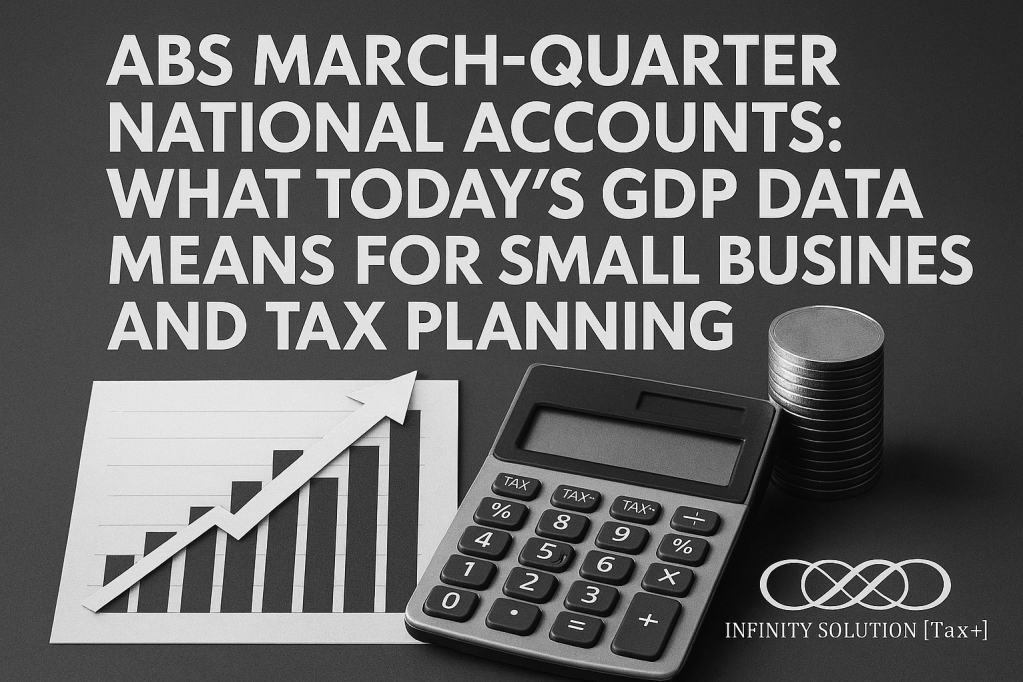
For small business owners in Box Hill and across Melbourne, today’s release of the ABS March‑quarter 2026 National Accounts is a timely reminder that EOFY tax planning now sits in a low‑growth, high‑cost environment. The Australian economy expanded by 0.3% in the March quarter, confirming modest growth rather than contraction — but also signalling subdued demand conditions heading into the 2025–26 year‑end. [abs.gov.au]
For SMEs working with an experienced accountant Box Hill, this data is not just economic background noise. It directly influences cash‑flow forecasting, deduction timing, ATO risk exposure, and forward tax strategy as businesses prepare for the new financial year.
What the ABS Data Actually Says
According to the Australian Bureau of Statistics, March‑quarter growth was supported primarily by government spending and service‑based activity, while household consumption remained weak. This aligns with persistent cost‑of‑living pressures and higher interest rates, dampening discretionary spending. Business investment growth was uneven, with several private‑sector categories showing softness rather than expansion.
Importantly, the data does not indicate a recession, but it does confirm that many businesses are operating in a low‑momentum trading environment. For tax purposes, this distinction matters: downturn‑related claims must be commercially justified, not assumed.
Why Slower Growth Changes EOFY Tax Planning
In lower‑growth periods, the ATO historically places greater emphasis on accuracy, substantiation, and timing, particularly where businesses report falling profits or losses. Claims for asset write‑offs, bad debts, obsolete stock, and prepayments remain legitimate — but only where documentation and commercial reasoning are sound.
For Box Hill SMEs, this is the time to review:
- Whether expenses genuinely relate to the current income year
- Whether asset purchases align with actual business use
- Whether bad debts have been properly identified and written off
Careful planning reduces audit risk while still maximising lawful deductions.
Cash Flow, Timing, and Commercial Reality
The ABS figures reinforce that cash‑flow management is now a tax issue, not just an operational one. Where revenue growth is uncertain, decisions around income recognition, expense timing, PAYG instalments, and GST reporting can materially affect liquidity in July and August.
Businesses using accrual accounting should ensure revenue is recognised correctly, while cash‑basis businesses should avoid deferring income without a genuine commercial basis. These are common trigger points during ATO reviews.
Interest Rates and Forward‑Looking Risk
The National Accounts sit alongside a restrictive interest‑rate environment, following recent Reserve Bank tightening. Higher borrowing costs increase pressure on margins and elevate the importance of realistic tax provisioning. Interest deductions remain claimable, but overstating future profitability can lead to underpaid tax and penalties. [rba.gov.au]
This is where working with a proactive accountant in Box Hill helps translate macro data into practical forecasts.
What Small Business Owners Should Do Now
Based on today’s ABS release, sensible EOFY actions include:
- Reviewing profit forecasts before finalising deductions
- Ensuring superannuation is paid by 30 June to remain deductible
- Updating depreciation schedules and asset registers
- Aligning tax estimates with conservative revenue assumptions
Professional advice tailored to local trading conditions remains critical. [pwc.com.au]
Conclusion
Today’s ABS National Accounts confirm that the Australian economy is growing — but slowly. For small businesses, this makes measured, compliant tax planning more important than ever. EOFY 2026 is not about aggressive minimisation; it is about aligning tax outcomes with commercial reality and regulatory expectations.
Disclaimer
This article is general information only and does not constitute tax, legal, or financial advice. Tax outcomes depend on individual circumstances. You should seek advice from a registered tax agent or accountant before acting on this information.