-
Context: Why Trusts Are Back in the Spotlight The 2026–27 Federal Budget has reignited intense debate around the taxation of trusts, with practitioners warning that certain structures may now face effective triple taxation. Industry commentary published this week highlights how new integrity measures and interaction effects between trust distributions, company tax, and personal marginal rates…
-
The 2026–27 Federal Budget confirmed that the $20,000 instant asset write‑off will be made a permanent feature of Australia’s small business tax system, ending years of temporary extensions and last‑minute legislative uncertainty. For eligible businesses, this reform provides greater confidence when planning capital expenditure — but it does not remove the need for careful timing,…
-
A Budget centred on structural tax reform The Federal Budget 2026–27, delivered on 12 May 2026, represents a major shift in Australia’s tax and economic policy settings. Treasurer Jim Chalmers framed the Budget as a move away from short‑term relief towards long‑term structural reform, with a focus on fairness, housing access, productivity, and fiscal sustainability.…
-
From 1 July 2026, Australian employers will be required to pay superannuation on or before each pay day, rather than quarterly. Known as Payday Super, this reform represents one of the most significant payroll and cash‑flow shifts in decades. In early May 2026, the Australian Taxation Office (ATO) released further guidance confirming that employers must…
-
The Reserve Bank of Australia (RBA) has increased the official cash rate by 25 basis points to 4.35% in May 2026, marking the third rate rise this year and fully unwinding the interest‑rate cuts delivered in 2025. The RBA cited renewed inflationary pressure—particularly from fuel prices and global economic instability—as the key driver of the…
-

Capital gains tax is back in the spotlight, with discussion that a future reform could replace the current 50% CGT discount for new investments with an inflation-indexation model. For people who own shares and ETFs, that makes record-keeping more important than ever. Even though no law has changed yet, investors should treat this as a…
-
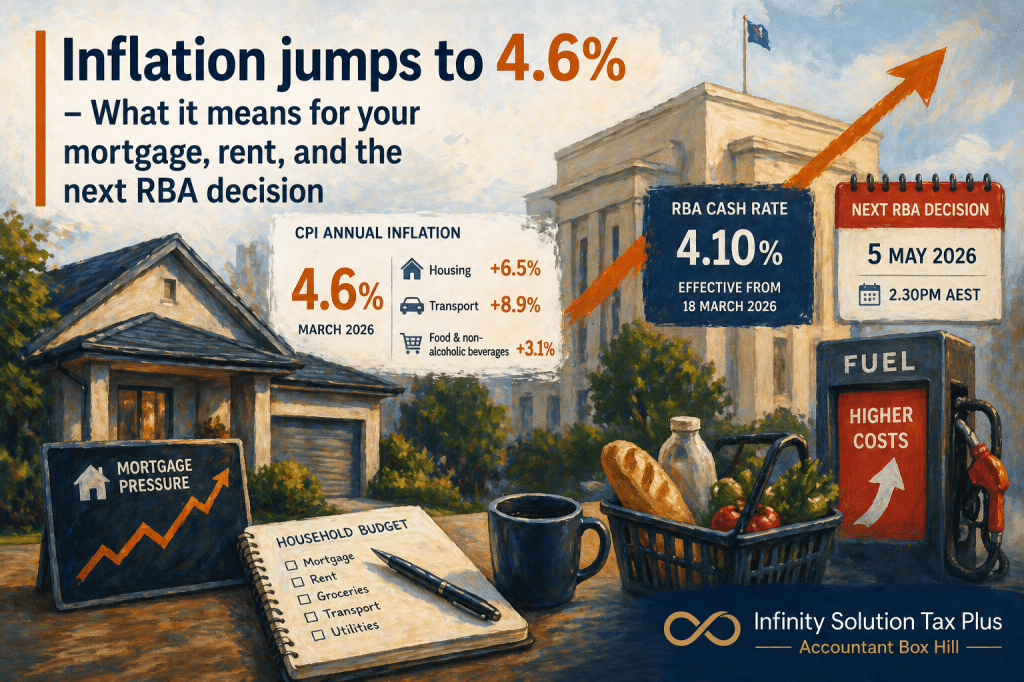
Australia’s inflation picture worsened on 29 April 2026, with the ABS reporting that annual CPI rose to 4.6% in March, up from 3.7% in February. The largest contributors were Housing (+6.5%), Transport (+8.9%), and Food and non-alcoholic beverages (+3.1%). For households, that means cost-of-living pressure is no longer just a headline story — it is…
-

The federal government is considering a major shift in how capital gains are taxed for new investments, moving away from the current 50% CGT discount and towards an “inflation indexation” approach. If implemented, this would be one of the most consequential tax changes property investors have faced in decades. For clients working with an accountant…
-
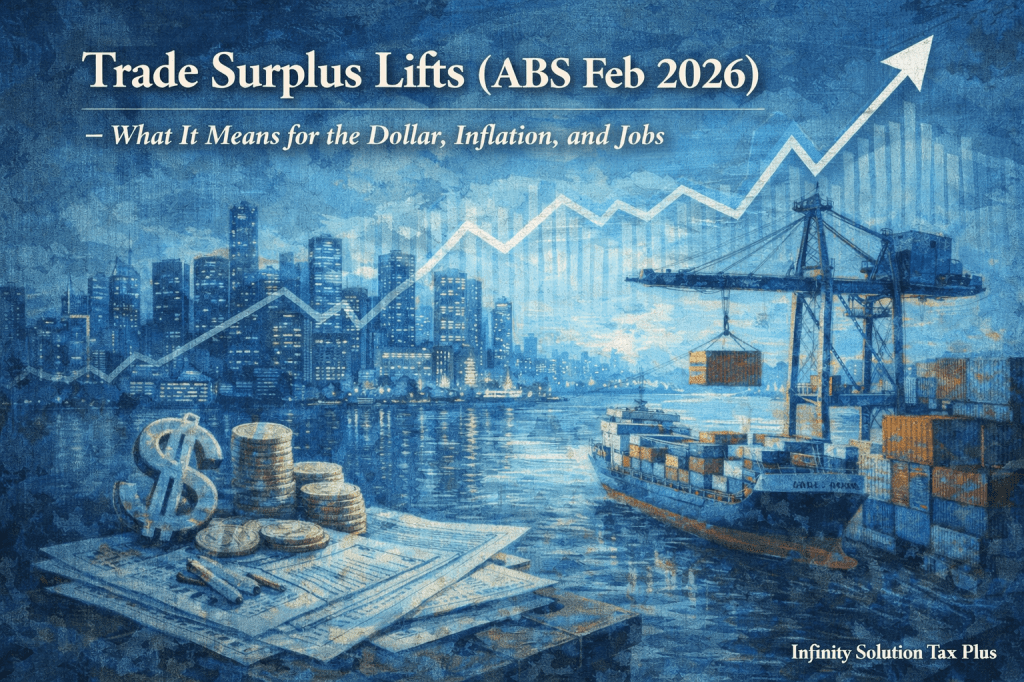
Australia’s latest trade figures show the goods trade surplus widened in February 2026, a reminder that shifts in export earnings and import spending can still ripple into day-to-day household outcomes. The ABS reported the seasonally adjusted balance on goods increased by $3,428 million in February, taking the surplus to $5,686 million. From an accountant Box…
-

Australia’s latest building approvals data delivered a sharp monthly lift in February 2026, offsetting all the losses in Jan, driven overwhelmingly by private sector dwellings excluding houses (the ABS category that captures apartments and other higher-density dwellings). It’s the sort of headline that can sound like “problem solved” on housing supply—but approvals are only the…
- Capital Gains Tax
- Cash Rate
- Climate Change
- Consumer Price Index
- cost of living
- Economy
- Finance
- General
- Global Economy
- Investment
- Labour Force
- Policy
- Property Development
- Superannuation
- Tax
- Tax Reform
- Tax Return
- Trust
- Vacant Residential Land Tax
Sienna Jiang is the Founder and Managing Director of Infinity Solution Tax Plus, a Chartered Accounting firm dedicated to helping clients stay financially organised while achieving their business, financial, and personal goals.
A Certified Public Accountant (CPA) with over 10 years of experience in accounting and taxation, Sienna brings broad and in-depth expertise in tax compliance, business advisory, financial reporting, and strategic tax planning for individuals and small businesses — including significant experience working with professionals in the medical field.
She works closely with clients to deliver tailored solutions in tax structuring, business strategy, and long-term planning. Her holistic approach combines practical guidance with personalised support, helping clients simplify compliance, drive growth, and reach their goals with confidence.