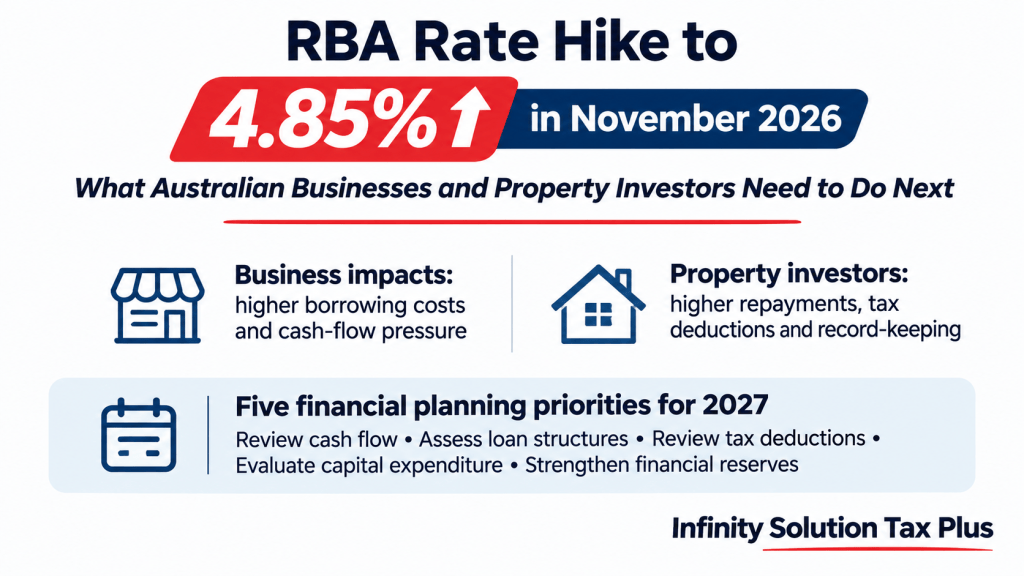
The Reserve Bank of Australia (RBA) increased the official cash rate by 25 basis points to 4.85% on 3 November 2026, its highest level since 2008. The decision marks the fifth rate increase this year, reflecting persistent inflation and continuing pressure on Australia’s economy. RBA Monetary Policy Decision
For Australian businesses and property investors, higher borrowing costs create additional challenges for cash flow, investment returns and financial planning. Working with an experienced accountant Box Hill businesses trust can help identify opportunities to manage financing expenses and strengthen financial resilience.
The RBA’s decision was not unanimous, with six Board members supporting the increase and three preferring to maintain rates at 4.60%. The Bank now expects inflation to remain elevated through much of 2027, reinforcing the importance of preparing for prolonged financial pressure.
How Higher Interest Rates Affect Australian Businesses
Businesses with variable-rate loans may experience increased repayments as lenders adjust their interest rates. Higher financing costs can reduce available working capital, affect profitability and delay expansion decisions.
For example, a 0.25 percentage point increase on a $1 million business loan represents approximately $2,500 in additional annual interest, assuming the full increase is passed through and the outstanding principal remains unchanged.
Business owners should reassess borrowing arrangements, monitor operating margins and update financial forecasts. The RBA’s outlook also indicates slower economic growth and continued inflationary pressures, making careful budgeting particularly important.
What the Rate Hike Means for Property Investors
Property investors face increased mortgage repayments, potentially lower net rental returns and reduced borrowing capacity.
However, higher interest expenses may also increase eligible tax deductions where borrowing relates to an income-producing rental property.
Under Australian Taxation Office (ATO) rules, investors may be entitled to deductions for:
- Interest on eligible investment property loans.
- Property management fees and insurance.
- Repairs and maintenance, subject to applicable rules.
- Eligible capital works and depreciation expenses.
Importantly, interest attributable to private borrowing is generally not deductible against rental income. Investors must maintain appropriate records and correctly apportion mixed-purpose loans. ATO Rental Property Guidance
A qualified Box Hill accountant can assist investors in reviewing deductions, loan arrangements and tax compliance.
Five Financial Planning Priorities for 2027
Businesses and investors should consider the following actions:
- Review cash-flow forecasts: Model higher borrowing costs and potential revenue fluctuations.
- Assess loan structures: Compare financing arrangements, repayment conditions, and refinancing costs.
- Review tax deductions: Maintain accurate documentation of eligible business and investment expenses.
- Evaluate capital expenditure: Consider financing requirements and applicable tax treatment before purchasing assets.
- Strengthen financial reserves: Maintain sufficient liquidity for loan repayments, taxation obligations and unexpected expenses.
For businesses operating in Box Hill, Doncaster and surrounding Melbourne suburbs, proactive accounting and tax planning can support more informed financial decisions.
How Infinity Solution Tax Plus Can Help
Infinity Solution Tax Plus provides accounting, taxation and business advisory services from its Box Hill office.
As a trusted accountant in Box Hill, the firm supports business owners and property investors with cash-flow planning, tax compliance, financial reporting and strategic accounting advice.
Early professional guidance can help identify financial risks and ensure important decisions reflect both current taxation requirements and changing economic conditions.
Final Thoughts
The RBA’s November 2026 increase to 4.85% reinforces the need for disciplined financial management. With inflation expected to remain elevated through much of 2027, businesses and investors should monitor future economic data and RBA decisions rather than rely on an early reduction in borrowing costs.
Reviewing financing arrangements, maintaining accurate tax records and planning ahead can help businesses and investors navigate uncertainty with greater confidence.
Disclaimer: This article contains general information only and does not constitute financial or taxation advice. You should seek personalised advice from a registered tax or financial professional.