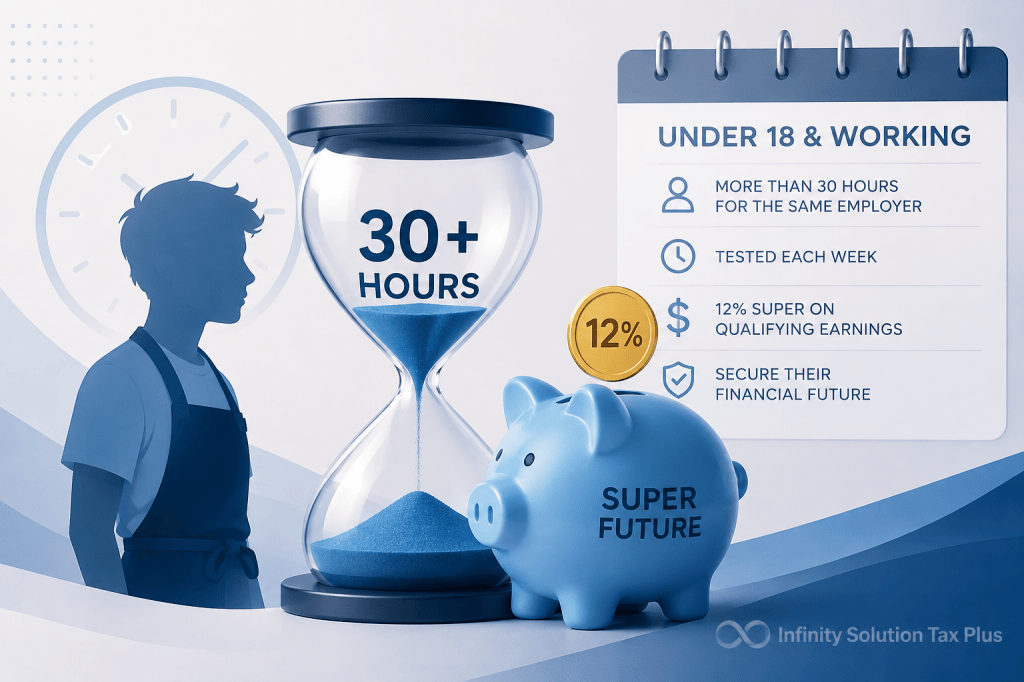
Australia’s superannuation rules treat most workers aged under 18 differently from adult employees. While workers aged 18 and over generally qualify for compulsory employer super regardless of their hours, an employee under 18 must currently work more than 30 hours in a week for the same employer before the super guarantee applies.
The rule is receiving renewed attention. Modelling by the Super Members Council, reported on 31 August 2026, estimates that young Australians could miss out on $411 million in super contributions during 2026–27. In Victoria alone, approximately 156,000 teenage workers are projected to miss an average of $735 each. These are industry estimates rather than government figures, but they highlight the potential long-term effect of excluding regular part-time work. ABC News
For families checking a teenager’s first payslips, an accountant Box Hill practice can help clarify whether the current threshold has been met and whether payroll records reflect the employee’s actual weekly hours.
How the 30-Hour Rule Works
The threshold is based on the hours actually worked during each individual week—not the employee’s contracted hours or an average across a fortnight or month.
The main rules are:
- The employee must work more than 30 hours, meaning exactly 30 hours is not sufficient.
- The test is applied separately to each employer. Hours from two different jobs are not combined.
- Eligibility can change from week to week.
- There is no minimum earnings threshold once the hours test is satisfied.
- Casual, part-time and full-time employees can qualify.
For example, a 17-year-old who usually works 12 hours a week but completes 34 hours during school holidays qualifies for compulsory super for the 34-hour week. If the same worker also performs six hours for another employer, the second employer does not have to pay super for that work under the current rule. Australian Taxation Office
How Much Super Should Be Paid?
For an eligible week, the employer must generally contribute 12% of the employee’s qualifying earnings. Qualifying earnings can include ordinary wages, paid leave, certain allowances, bonuses and commissions, although some payments—such as particular overtime amounts—may be treated differently.
Since 1 July 2026, Payday Super rules generally require eligible contributions to reach the employee’s fund within seven business days after payday. Young workers and parents should therefore check both the payslip or payroll record and the super fund account rather than assuming a contribution has been made. Fair Work Ombudsman
What Young Workers and Parents Should Check
Keep weekly timesheets, rosters and payslips, particularly during school holidays or busy retail and hospitality periods when hours may exceed the threshold. Confirm that the employer has the correct super fund details and investigate promptly when an eligible contribution does not appear.
Young workers should also avoid creating unnecessary duplicate accounts. When comparing funds, consider long-term performance, fees, investment choices, insurance costs and available services—not simply a single annual return. Moneysmart
Infinity Solution Tax Plus, as a trusted Box Hill accountant, can assist families and employers with payroll reviews, super calculations, record-keeping and the tax implications of employing young workers. Early checking can prevent missed entitlements and reduce the risk of employers becoming liable for the super guarantee charge.
Final Thoughts
A private senator’s bill seeking to remove the under-18 hours exemption is currently before the Senate. It was referred to the Senate Economics Legislation Committee, which is due to report by 17 November 2026. Until legislation is passed and commenced, however, the more-than-30-hours rule remains in force. Families and employers should follow developments and seek guidance from a Trusted accountant in Box Hill before relying on any proposed change. Parliament of Australia
Disclaimer: This article contains general information only and does not constitute financial or taxation advice. You should seek personalised advice from a registered tax or financial professional.




 Infinity Solution Tax Plus