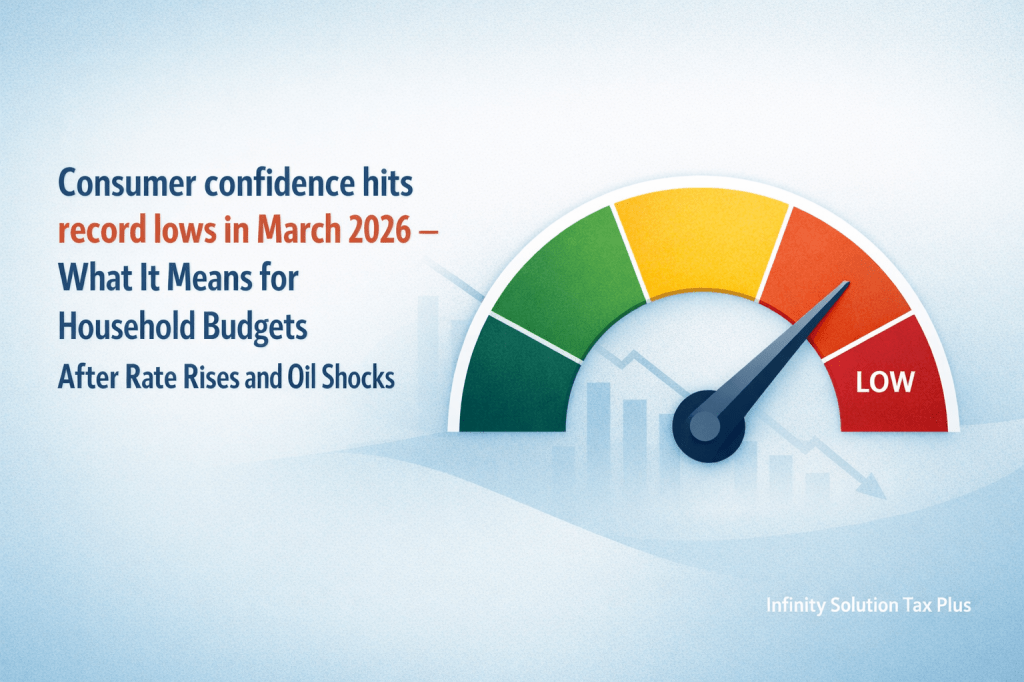
Australians are reporting some of the weakest consumer sentiment levels seen in decades, with ANZ-Roy Morgan figures (as reported this week) pointing to a reading around 63.1 — among the lowest levels recorded since the series began in 1973. When confidence falls this far, it tends to show up in everyday decisions: delaying big purchases, cutting discretionary spending, and feeling “behind” even when income hasn’t changed. If you’re already working with an accountant Box Hill, this is the kind of week where a simple budget stress-test can quickly reduce uncertainty and improve cash-flow control.
The economic backdrop is doing households no favours. On 17 March 2026, the Reserve Bank of Australia lifted the cash rate target by 25 basis points to 4.10%, noting that higher fuel prices linked to Middle East tensions could add to inflation if sustained, and that short-term inflation expectations had increased. In practical terms, higher loan repayments combined with rising transport costs can place pressure on household budgets at the same time.
Inflation also remains elevated in key household categories. The ABS reported annual CPI inflation at 3.8% in the 12 months to January 2026, with trimmed mean inflation at 3.4% — indicating that underlying price pressures remain broader than isolated items. Housing continues to be a significant contributor to inflation, which matters because housing costs are typically the least flexible component of the family budget.
What the confidence data is really telling households right now
Confidence surveys don’t predict individual financial outcomes, but they do capture broad shifts in behaviour: when people feel less secure, they often reduce discretionary spending, increase precautionary savings where possible, and become more cautious about taking on new debt. Roy Morgan’s March commentary highlights how sentiment can shift quickly when petrol prices and interest rate expectations rise together — and why that combination can reinforce household caution.
A simple stress-test you can run in 30 minutes
- Baseline your “non-negotiables.”
List the essentials that will still be there next week:
- Rent/mortgage, utilities, insurance, phone/internet
- Childcare/school costs
- Minimum debt repayments
- Groceries and basic transport
If you don’t already have your totals in one place, use the last 4–8 weeks of transactions and group them into categories.
- Run a “squeeze” scenario
Assume everyday essentials rise by 10–15% over the next month (this is a stress-test, not a forecast). Then ask:
- What adjusts first (savings contributions, discretionary spend, extra debt repayments)?
- What can be paused quickly (subscriptions, delivery meals, non-urgent purchases)?
- Which bills could potentially be renegotiated (insurance, phone plans, internet)?
- Run a “shock” scenario
Assume both happen at once:
- Your loan repayments rise again (even a modest increase can affect cash flow), and
- Your weekly fuel or transport costs increase materially.
Your goal isn’t to predict the future; it’s to identify two or three actions that protect cash flow quickly (for example: switching to weekly budgeting, setting a fuel spending cap, or temporarily redirecting discretionary spending into a buffer account).
Policy settings that may help cash flow (and when they start)
While households can’t control global oil markets or interest rates, some government measures may provide modest relief. The 2025–26 Federal Budget outlines further personal income tax cuts from 1 July 2026 (including reducing the 16% marginal tax rate to 15% for taxable income between $18,201 and $45,000) and continuing energy bill relief measures aimed at easing essential cost pressures.
Who’s most exposed (and what to prioritise this week)
Households that may feel pressure more quickly include:
- Variable-rate mortgage holders and recent borrowers
- Renters facing lease renewals in tight rental markets
- Families with long commutes or high fuel dependence
- Individuals carrying multiple consumer debts, where small repayments compound cash flow strain
In these conditions, the most effective first step is clarity: one page showing baseline expenses, available buffer savings, and the next four weeks of scheduled bills.
A practical next step
If you want help turning current economic uncertainty into a clearer financial plan — particularly around structuring savings buffers, reviewing deductible expenses, or preparing for 1 July tax changes — Infinity Solution Tax Plus can assist as your Box Hill accountant with proactive budgeting and tax guidance.
Final thoughts
Consumer confidence is a useful signal that many households are feeling financial pressure. While it doesn’t determine individual outcomes, it can serve as a prompt to strengthen budgeting systems before stress escalates. A short, disciplined stress-test now may reduce the risk of reactive decisions later, particularly if fuel volatility persists or interest rates remain restrictive. If you’d like a second set of eyes on your numbers, speak with a trusted accountant in Box Hill and focus on early, practical planning rather than last-minute adjustments.
Disclaimer: This article contains general information only and does not constitute financial or taxation advice. You should seek personalised advice from a registered tax or financial professional.




 Infinity Solution Tax Plus