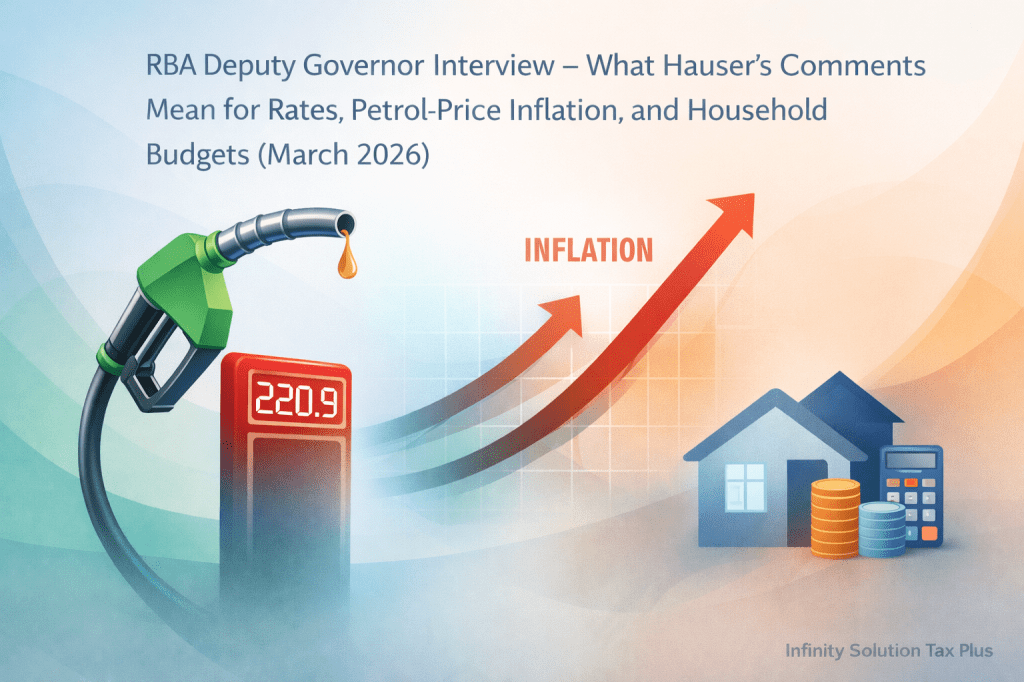
Petrol prices have jumped sharply through early March 2026, and the Reserve Bank of Australia (RBA) is openly talking about how an energy shock can flow into inflation, expectations, and (potentially) interest-rate decisions. Reports of widespread pump-price rises and market scrutiny have been covered by ABC News and the ACCC in recent days.
In a 10 March 2026 podcast interview, Deputy Governor Andrew Hauser described oil-market volatility as the key uncertainty, while noting that higher fuel costs can push up inflation directly and indirectly.
For households, the near-term anxiety is understandable: if higher petrol prices lift measured inflation and keep inflation expectations “sticky”, the RBA may feel pressure to tighten policy even if the shock also slows spending. (Economically, an oil shock is a classic “stagflationary” impulse: it can raise headline inflation while also squeezing real incomes and demand.) If you’re trying to translate these macro signals into practical choices—mortgage budgeting, refinancing timing, or cash-flow buffers—a local accountant Box Hill can help model scenarios against your actual income and expenses.
What Hauser said
Oil volatility is the starting point
Hauser’s core message was that the oil price is moving fast, and policy analysis has to work with real-time updates and “what if” scenarios. In the interview, he pointed to large swings in Brent crude around the end-February conflict escalation, and emphasised the risk of disruption through the Strait of Hormuz as a key driver of uncertainty (including the point that a large share of global oil flows through the Strait).
How petrol becomes an inflation problem
Hauser outlined several channels:
- Immediate price impact: higher petrol costs show up quickly at the pump.
- Second-round impacts: fuel costs can push up firms’ costs and prices over time (for example, via freight, logistics, and energy-intensive inputs).
Expectations risk: persistent price spikes can influence how people think about future wages and prices.
This “expectations” channel matters because central banks worry less about a one-off jump, and more about whether it changes behaviour—workers seeking higher wage increases, businesses raising prices in anticipation, and consumers changing spending patterns. In practice, the RBA tends to “look through” temporary first-round price spikes, but becomes more concerned if the shock appears to broaden into underlying inflation (for example, via wage and price-setting).
Why does this change the rate conversation
The RBA’s most recent policy statement (3 February 2026) sets the baseline: the Board lifted the cash rate target by 25 basis points to 3.85%, noting inflation picked up in the second half of 2025 and that capacity pressures and a tight labour market could keep inflation above target for some time. The RBA’s cash rate target listing also shows 3.85% effective from 4 February 2026, with the next update scheduled for 17 March 2026.
Hauser’s interview doesn’t “pre-announce” a decision, but it does reinforce that the Bank is weighing an energy shock against an economy with limited spare capacity—exactly the kind of backdrop where inflation risks can dominate even while growth risks rise.
Implications and who benefits (or feels it most)
Mortgage holders and renters
If markets (and lenders) price in further rate rises, variable mortgage repayments can move quickly. Even without an immediate RBA move, funding costs and fixed-rate pricing can tighten as expectations shift. The practical takeaway is to stress-test your budget for higher repayments and review whether refinancing, fixing part of the loan, or accelerating an offset strategy makes sense.
Households absorbing the fuel shock
Fuel is a recurring cost with few short-term substitutes for many commuters. That makes budgeting discipline important: ring-fence essentials, build a “price-spike buffer”, and avoid locking in new discretionary commitments until volatility settles. A practical economic point here is that higher fuel costs act like a temporary “tax” on households: more spending on petrol often means less capacity for discretionary spending elsewhere, which can slow parts of the economy even as headline inflation rises.
Infinity Solution Tax Plus, your local Box Hill accountant, can help you turn “rate talk” into a household plan—budget stress tests, cash-flow forecasting, and timing decisions that align with your broader tax and financial position. A Box Hill accountant can also coordinate this with end-of-year planning, so you’re not making reactive choices in a high-noise news cycle.
Final thoughts
Hauser’s comments underline that petrol-price inflation isn’t just a cost-of-living headline—it can become a policy issue if it feeds into broader pricing behaviour. The next few RBA communications and data prints will matter because the Bank is balancing inflation risks against the drag an energy shock can place on growth. If you want a clear, numbers-based view of your options, speak with a trusted accountant in Box Hill.
Disclaimer: This article contains general information only and does not constitute financial or taxation advice. You should seek personalised advice from a registered tax or financial professional.


 Infinity Solution Tax Plus