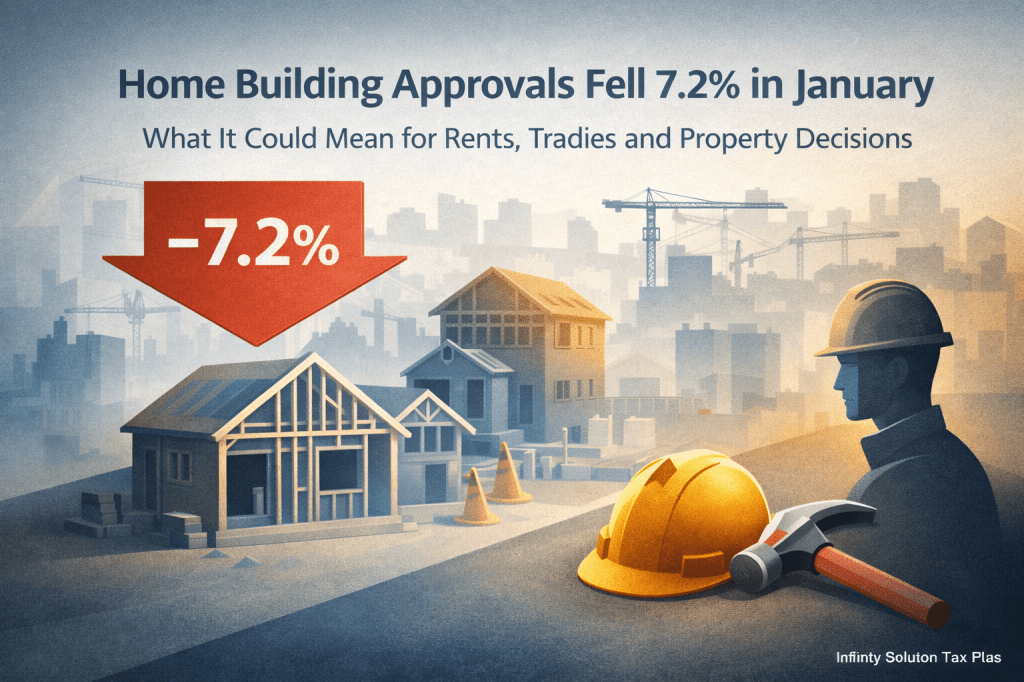
The Australian Bureau of Statistics (ABS) reported that total dwelling approvals fell 7.2% in January 2026, signalling a renewed slowdown in new housing approvals.
Detailed data from the January 2026 Building Approvals release confirms the monthly decline across dwelling categories, reinforcing concerns about construction momentum at a time when rental pressure and affordability remain key national issues.
For households, investors and small construction businesses, approvals are more than just a headline figure — they are a forward indicator of future supply, employment activity and rental market conditions. Many clients speaking with an accountant Box Hill are now asking what this slowdown could mean for their next property or investment decision.
Why Building Approvals Matter
Building approvals measure the number and value of dwellings authorised for construction and typically lead actual building activity by several months.
While approvals do not guarantee completion, they are widely used as a leading indicator of future housing supply and construction sector activity.
When approvals fall:
- Future housing supply growth may slow
- Construction sector workloads may decline
- Employment for tradies and subcontractors may fluctuate
- Rental supply additions may moderate
Fewer approvals today often translate into fewer completed homes over the following 6–18 months, depending on project size and financing conditions.
What This Could Mean for Rents
Australia’s rental market remains sensitive to supply changes. The latest Consumer Price Index release for January 2026 provides a broader housing cost context, including rent movements within inflation data.
If new dwelling supply slows further:
- Vacancy rates may remain tight in undersupplied markets
- Landlords may retain pricing power in constrained areas
- Rent growth may remain elevated in certain regions
However, rental outcomes vary significantly by location and dwelling type. Inner-city apartment markets may behave differently from outer suburban housing corridors, particularly where prior building cycles have created differing supply conditions.
For investors, rising rents may improve gross yield — but higher interest rates, insurance costs, maintenance, and land tax must also be factored into net return calculations.
Impact on Tradies and the Construction Sector
For builders, subcontractors, and suppliers, approvals are a pipeline indicator of future work rather than immediate activity.
A sustained decline may result in:
- Reduced forward bookings
- Increased competition for projects
- Greater cash-flow volatility
- Higher insolvency risk for highly leveraged operators
However, short-term impacts can vary depending on existing work backlogs and infrastructure projects already underway.
Construction businesses should review cash buffers, debtor management, and tax compliance obligations carefully. A proactive review with a Box Hill accountant can help ensure BAS, PAYG, and super obligations remain manageable if turnover slows.
What It Means for Property Investors
For investors weighing a purchase decision, falling approvals can send mixed signals.
Potential positives:
- Future supply constraints may support property values in undersupplied markets
- Rental growth may remain firm where vacancy rates are low
Potential risks:
- Higher construction costs
- Financing uncertainty
- Interest rate volatility
- Project delays or developer cancellations
Investors should also understand allowable deductions and record-keeping requirements for rental properties, as outlined by the ATO (https://www.ato.gov.au/individuals-and-families/investments-and-assets/property-and-land/residential-rental-properties/rental-expenses/how-to-claim-rental-expenses
).
Cash flow — not just projected capital growth — should guide decision-making in the current environment.
Broader Housing and Affordability Considerations
Housing supply remains a structural economic issue. If approvals continue to weaken over multiple months, policy pressure may increase for planning reform, infrastructure coordination, and supply acceleration measures.
For first-home buyers, slower approvals could mean:
- Less new stock entering the market in future periods
- Continued competition for established properties
However, market outcomes will also depend on population growth, migration settings, credit conditions, and broader economic trends.
Infinity Solution Tax Plus, as a trusted accountant in Box Hill, works with property owners, investors, and small construction operators to assess tax position, borrowing structure, and long-term sustainability before major financial commitments are made.
Final Thoughts
A 7.2% monthly decline in approvals is not just a statistical movement — it is an early signal about potential changes in the housing construction pipeline.
Whether this translates into sustained rental pressure or a broader construction slowdown will depend on interest rates, developer confidence, financing conditions, and economic activity in the months ahead.
In property decisions, timing and structure matter. Reviewing cash flow, tax implications, and borrowing capacity early can reduce risk later.
Disclaimer: This article contains general information only and does not constitute financial or taxation advice. You should seek personalised advice from a registered tax or financial professional.




 Infinity Solution Tax Plus