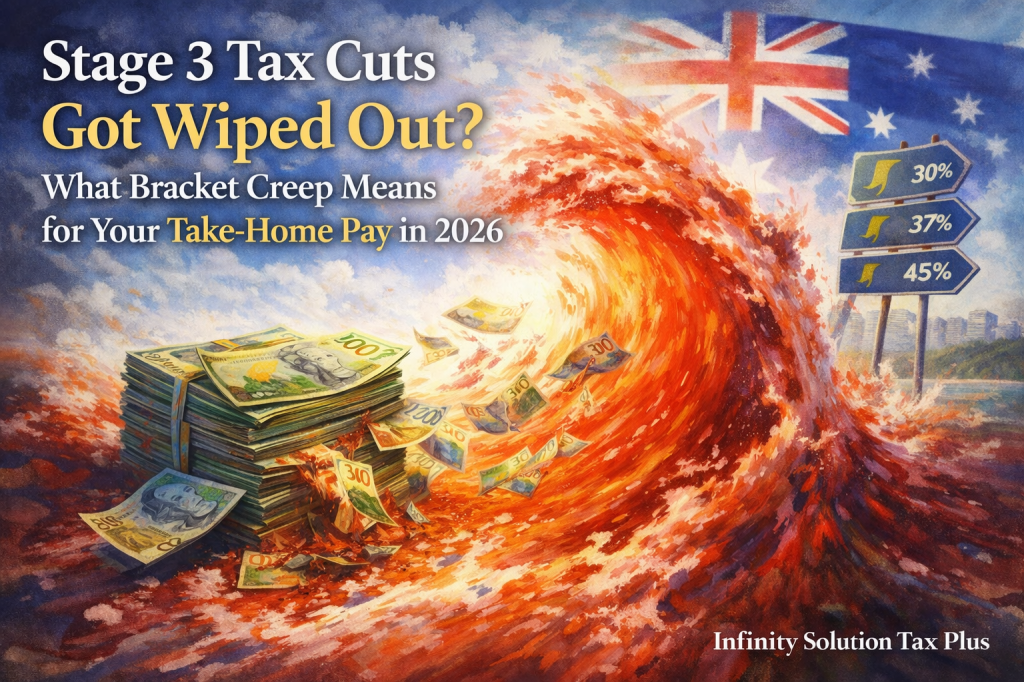
Recent commentary suggests that for some Australians, the benefit of earlier tax cuts can feel smaller over time as incomes rise — a phenomenon commonly referred to as “bracket creep”. Bracket creep describes what happens when income growth causes people to pay a higher average rate of tax over time, particularly when tax thresholds don’t move unless the government changes them. The debate has resurfaced alongside broader Treasury tax modelling discussions.
At the same time, the Federal Budget 2025–26 outlines further personal income tax changes designed to deliver additional relief in the coming years. With inflation still shaping household finances and the Reserve Bank holding the cash rate at 3.85% as of February 2026, many taxpayers are asking: why doesn’t my pay rise feel like a real pay rise?
For clients speaking with an experienced accountant Box Hill, the answer often lies in how Australia’s progressive tax system works — and how small changes in income can change the tax paid on the “next dollar” you earn.
What Is Bracket Creep?
Bracket creep occurs when your income rises over time (often due to inflation-linked wage increases), but tax thresholds don’t automatically rise in line. As a result, more of your income is taxed at higher marginal rates, and your average tax rate can increase.
As a result:
- A larger portion of your income falls into higher tax brackets
- Your average tax rate rises
- Your after-tax gain from a pay increase shrinks
Importantly, you may not jump into a dramatically higher bracket — but incremental increases in taxable income can still increase total tax payable.
In periods of elevated inflation, this effect becomes more noticeable because wage adjustments may reflect cost-of-living pressures rather than a real increase in purchasing power.
What Happened to the Stage 3 Tax Cuts?
Australia’s personal income tax settings have changed over recent years, including the redesigned Stage 3 tax cuts that began from 1 July 2024.
The 2025–26 Budget also confirms additional tax cuts scheduled across 2026–27 and 2027–28:
- From 1 July 2026, the 16% rate (for taxable income between $18,201 and $45,000) is scheduled to reduce to 15%
- From 1 July 2027, that same rate is scheduled to reduce further to 14%
However, tax cuts can be offset in real life over time if:
- Wages rise (especially during inflation)
- Tax thresholds remain fixed unless changed by the government
- Medicare levy impacts change as incomes move (including when low-income thresholds and related effects no longer apply)
This is why some households feel earlier tax relief has been “wiped out” — not because tax rates increased, but because income growth can steadily push them into higher effective tax outcomes.
Online tools and calculators have illustrated how even modest income increases can affect take-home pay under these settings.
How to Check If Bracket Creep Is Affecting You
A practical review involves:
- Comparing your taxable income this year versus two or three years ago
- Reviewing your marginal tax rate (the rate on your next dollar of income)
- Checking whether offsets or thresholds that previously reduced tax outcomes no longer apply
- Calculating your effective tax rate (total tax ÷ taxable income)
Even a small rise in your effective rate can reduce the real benefit of a salary increase.
A qualified Box Hill accountant can model:
- Your projected tax over the next two financial years
- The impact of scheduled tax rate reductions in 2026 and 2027
- Whether salary packaging or legitimate deduction strategies improve after-tax outcomes
Why This Matters in 2026
The Reserve Bank’s monetary policy settings reflect ongoing inflation management. When wages adjust upward in response to inflation, bracket creep tends to become more noticeable unless thresholds are adjusted through policy changes.
For households managing mortgages, school fees, or rising living costs, understanding take-home pay — not just gross salary — is critical for budgeting and planning.
Planning Ahead
Rather than focusing solely on headline tax cuts, taxpayers should:
- Review PAYG withholding (to reduce surprises at tax time)
- Consider deductible super contributions where appropriate
- Time capital gains or other taxable events strategically (based on confirmed rules, not speculation)
- Monitor announced future tax rate changes.
Working with a trusted accountant in Box Hill ensures you understand both current law and scheduled changes — so your financial decisions reflect after-tax reality, not assumptions.
Final Thoughts
Bracket creep is not a new tax, but it is a powerful feature of a progressive tax system during inflationary periods, and it can gradually reduce how much of each pay rise you actually keep. While further income tax reductions are scheduled, their real-world impact depends on income growth, inflation, and household circumstances.
The key is proactive review. Understanding your marginal rate, effective rate, and future settings can make a meaningful difference to long-term financial outcomes.
Disclaimer: This article contains general information only and does not constitute financial or taxation advice. You should seek personalised advice from a registered tax or financial professional.



 Infinity Solution Tax Plus